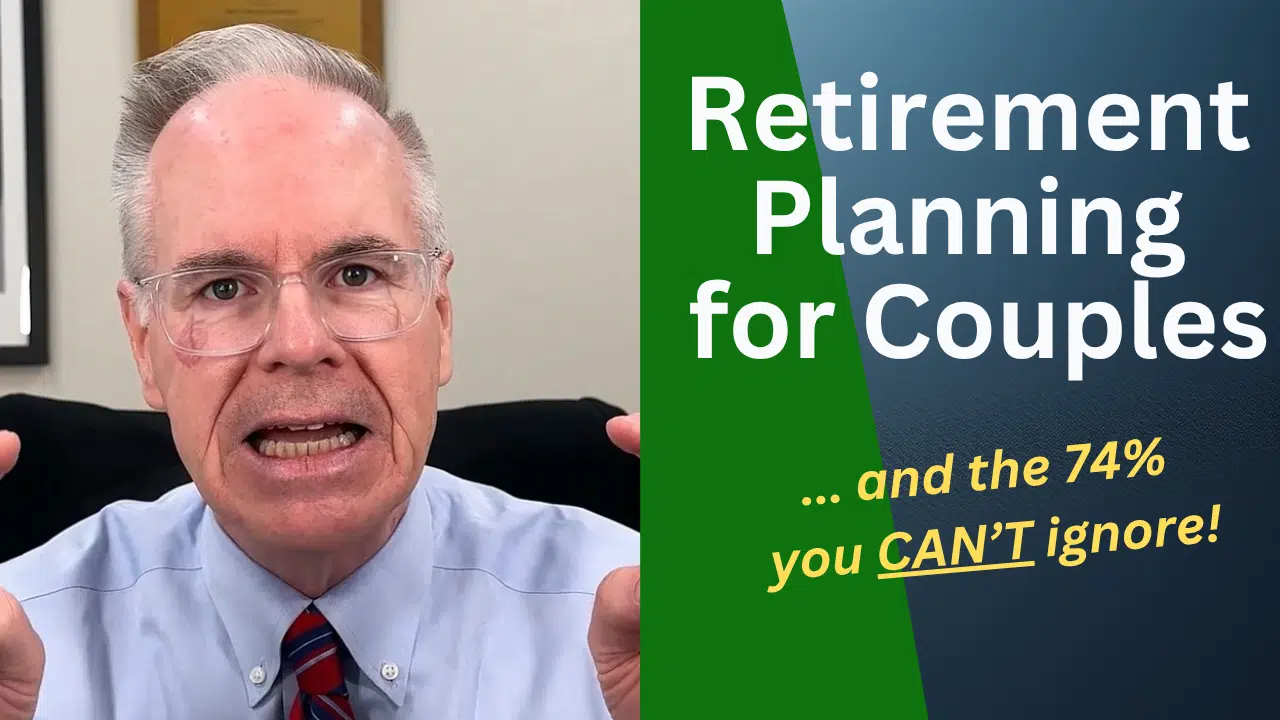
Retirement Planning For Couples: The 74% You Can’t Ignore
When we’re retirement planning for couples, there’s something worth thinking about.
When statisticians say there’s a 74% probability of something happening, they don’t call that a risk to manage.
They call that an expected outcome.
And according to J.P. Morgan’s 2026 Guide to Retirement, a 65-year-old couple today has exactly that — a 74% chance that at least one partner reaches age 90. That’s 25 years from now.
It raises a question: is your retirement plan built to last that long?
And here’s the part that often surprises people: average life expectancy is a midpoint, not a finish line.
Half of all couples will see one partner live beyond whatever the average says.
Most Retirement Plans Aren’t Built for This
Many couples we work with have mentally planned to somewhere around age 85. That’s understandable — it feels like a long time from where they’re sitting today.
Retirement planning for couples isn’t just about accumulating enough — it’s about building a plan that holds up across a timeline that’s longer than most people expect, and that protects whichever spouse lives longest.
Three decisions that matter most, and they’re all best addressed in the years closest to retirement.
Decision One: Social Security Timing
J.P. Morgan’s 2026 Guide to Retirement shows that the difference between claiming Social Security early versus waiting until age 70 could possibly amount to roughly $2,300 per month — permanently. For retirement planning for couples, this number carries particular weight.
The higher earner’s benefit isn’t just their income — it becomes the foundation of the survivor’s financial security for potentially decades.
Maximizing that benefit by delaying to 70 is one of the most consequential decisions in retirement planning for couples, particularly when a 30-year horizon is on the table.
Decision Two: Withdrawal Strategy
A 30-year retirement horizon changes how a couple needs to think about withdrawal rates. J.P. Morgan’s modeling in their 2026 Guide to Retirement illustrates this clearly: the difference between a 4% annual withdrawal rate and a 5% annual withdrawal rate — on the exact same portfolio, with the exact same investments — can drop the probability of success over a 30-year period from the 90% range down to the mid-60s.
One percentage point. Same portfolio. Meaningfully different outcomes.
And that gap widens further when market timing works against you. A downturn in the early years of retirement, when the portfolio is at its largest, does damage that’s difficult to recover from over a long withdrawal period. Sequence of return risk is one of the least discussed and most important elements of retirement planning for couples with a long horizon ahead of them.
Decision Three: Planning for the Surviving Spouse
This is the conversation that most retirement plans haven’t had yet — and the one that matters most over a 30-year horizon.
When one spouse passes away, the financial picture shifts in several ways simultaneously. Two Social Security checks become one. Tax filing status changes from married filing jointly to single — which means the same income is now taxed at higher rates.
But fixed household expenses don’t drop drastically just because one person is gone.
The years between 65 and 75 are the most important window for retirement planning for couples to address this directly. Roth conversions, beneficiary designations, and explicitly modeling the survivor’s budget and income picture are all conversations that are far easier — and far more effective — when both spouses are at the table.
Most couples haven’t done this modeling yet. The ones who have are in a meaningfully better position.
A 74% Probability Deserves a Plan Built Around It
A 74% probability isn’t something you plan around. It’s something you plan for.
If you and your spouse are within five years of retirement, the most useful thing you can do right now is stress-test your plan against a genuine 30-year horizon — and make sure your Social Security strategy, withdrawal approach, and surviving spouse scenario have all been explicitly addressed.
Source: J.P. Morgan Asset Management, 2026 Guide to Retirement (link below) This post is for informational and educational purposes only. It is not intended as personalized financial, tax, or legal advice. Please consult a qualified professional regarding your specific situation.
Retirement Planning For Couples: The 74% You Can’t Ignore – Links
Catch all our Mullooly Asset videos here
Subscribe to the Mullooly Asset YouTube Channel
Watch this episode (“Retirement Planning for Couples: The 74% You Can’t Ignore”) on our YouTube Channel
JP Morgan 2026 Guide to Retirement
Retirement Planning For Couples: The 74% You Can’t Ignore – Transcript
Here’s something worth thinking about.
When statistics say there’s a 74% probability of something happening……
you should believe that.
That’s not a risk that needs to be “managed.”
That’s called an “expected” outcome when 74% of the time this happens.
And according to J.P. Morgan’s 2026 Guide to Retirement, a 65-year-old couple today in 2026 has exactly that……
a 74% chance that at least one partner reaches age 90.
That’s a long way off.
That’s 25 years into the future.
So the real question isn’t whether your retirement plan can “last” that long.
It’s whether it was actually “built to last” that long.
Now, a lot of couples that we sit down with and do plans with, have mentally thought about, “Well, we need a plan that’s going to last into our early to mid-80s, somewhere maybe age 85.”
That’s pretty understandable.
But when three out of four couples see a situation where at least one partner is going to reach age 90……
…planning to 85 means there’s a real chance that your plan could run out — before the person actually runs out.
So what does building a plan around that reality actually look like?
There’s three decisions that matter the most.
The first decision is regarding Social Security timing.
J.P. Morgan’s data, in the report, shows the difference between claiming early versus waiting until age 70 could mean roughly $2,300 per month permanently.
So for a couple, the higher earner’s benefit is the one that the surviving spouse keeps for the rest of their life.
Maximizing that number is one of the most effective ways to protect whoever lives longer.
The second deciding point to consider is the withdrawal strategy.
A 30-year “retirement horizon” changes how you need to think about these withdrawal rates that you’re taking, how you’re withdrawing from your assets.
The modeling in the J.P. Morgan report — and we’ll link to that report — in the show notes,
just a difference of 1% — between 4% a year withdrawal rate and a 5% a year withdrawal rate – on the very same portfolio, can drop the probability of success over a 30-year timeline from the 90% range success rate down to something in the mid-60s.
That’s the very same portfolio…
The very same investments…
Just one percentage point difference apart in withdrawals.
Any kind of market downturn, especially early on – in the early years of when you’re drawing down the portfolio, that makes these numbers even more consequential.
When your portfolio is at its largest, if you have early losses early on as you retire in your 60s, it’s harder to recover from.
Okay, the third decision point to consider is planning for the surviving spouse.
So when one spouse passes away, the financial picture shifts all at the same time.
You go from two Social Security checks, down to one.
The tax filing status changes from married to individual filer.
That’s a tremendous drop-off — that a lot of people aren’t even really talking about.
But the fixed expenses really don’t change, all that much.
The years between 65 and 70 are when you need to start mapping these things out and considering them.
It’s the most important period of time to address this.
And most couples haven’t really modeled for things like this.
A 74% probability isn’t something that you plan “around.”
It should be something that you plan FOR.
If you’re within five years of retirement, and you’d like to “stress test” YOUR plan —
against a timeline like that, we welcome the conversation.
There’s a link below to schedule time with our team.
And we’ll link to that J.P. Morgan 2026 Guide to Retirement.
It’s worth reading all on its own.
We’ll link to that down in the show notes as well.
Thanks for watching “Retirement Planning for Couples: The 74% You Can’t Ignore”