The Dow Jones 1976 vs. Today: What Survived?
The Dow Jones 1976 – on July 4, 1976, the 30 companies making up the Dow Jones Industrial Average were considered the biggest, most permanent-seeming names across the fruited plain.
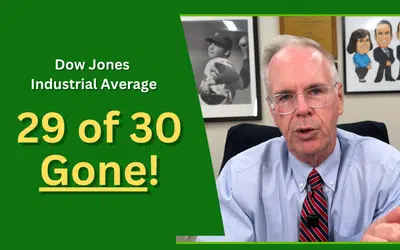
Fifty years later, twenty-nine of them have been dropped from the index.
Some are gone entirely.
Meanwhile, the Dow Jones 1976 through 2026 – went from roughly 1,000 to approximately 50,000.
That does NOT include dividends.
The lesson isn’t about picking the right stocks.
It’s about what owning an index does for you automatically — the selling, the weightings, the rebalancing — while you get on with your life.
For general informational purposes only.
Not a recommendation to buy or sell any security.
Past performance does not guarantee future results.
- Worth noting: On July 4, 1976 there was no way for an *individual* investor to simply own the whole Dow Jones index. A few weeks later, folks could own another index – the S&P 500 as a basket – for the first time ever.
On August 31, 1976, John Bogle launched the First Index Investment Trust. This was the first index fund available to individual investors. Today it’s the Vanguard 500 Index Fund. Bogle hoped to raise $50 to $150 million. He raised about $11 million. People called it “Bogle’s Folly.” Some said indexing was a fad that would be gone in a few years.
Links for The Dow Jones 1976 vs. Today: What Survived?
Catch all our Mullooly Asset videos here
Subscribe to the Mullooly Asset YouTube Channel
Watch this episode (“Dow Jones 1976 vs. Today: What Survived?”) on our YouTube Channel
Transcript for The Dow Jones 1976 vs. Today: What Survived?
Here’s a list of the 30 companies that made up the Dow Jones Industrial Average on July 4th, 1976.
The Dow Jones, at that time, 50 years ago, was bouncing around 1,000.
Take a look where the Dow Jones Industrial Average is today.
We’ve gone from roughly 1,000 to approximately 50,000 over the last 50 years.
Incidentally, that move from around 1,000 to approximately 50,000……
…..on the day we’re recording this, we’re at 52,000……
….that move only covers the price.
The numbers only get better when you consider there’s been 50 years of dividends piled on top of these crazy returns.
But take a look at those 30 names.
Every single one of those names 50 years ago, in 1976….. they looked permanent.
They weren’t going anywhere.
Those companies were bulletproof.
These were some of the biggest companies in the United States 50 years ago.
And now?
Most of them have been dropped from the index.
They’re gone.
And some of these companies are gone completely.
You didn’t need to know which ones were going to make it – and which ones weren’t.
If you simply owned the entire basket (the index), you’d have been carried along the whole way from 1,000 to 50,000 without having to pick a single winner.
Now, in 1976, that was impossible to do.
There was no product, no fund…. or exchange traded fund, no ETF, that you could own that would buy the entire index.
Our point is, a lot of companies in the index came and went.
Along the way, 29…. TWENTY-NINE
…..of the 30 companies were DROPPED from this index.
A couple came back.
The results, however, came from owning the index.
The only company that has been on the list for the entire 50 years, is Procter & Gamble.
It’s the only one.
Two other companies were on the list in 1976. And now they’re back.
So let me explain what happened here.
Standard Oil of California in 1976 was a member of the Dow Jones Industrial Average.
They renamed themselves into Chevron.
And along the way, Chevron also acquired Texaco.
So two companies were on the list, came off the list, and came back.
Now, Chevron was dropped in 1999 from the index.
But they were added back in 2008.
So from 50 years ago, 1976, technically, just three names have survived.
But our point is not that the Dow Jones Industrial Average is a good investment.
Or a good investment for you.
We don’t know if it’ll be a good investment going forward.
And it’s not that Procter & Gamble or Chevron was (or is) a good investment.
We don’t know if they’re going to be good investments going forward.
Our point is that today, owning an index, ANY INDEX, through a mutual fund or an exchange traded fund, an ETF…..
….may make your investment experience a little better.
A couple of things come to mind.
You don’t have to select the individual stocks.
The index does it for you.
You don’t have to know when to sell a particular stock.
The index does it for you.
You don’t have to get the weightings, the rebalancing, or the allocations right.
The index does this for you.
So when the stocks inside of an index change, it tends to be more tax efficient than dealing with:
1. I have to sell the individual stocks.
2. I have to buy the new stock.
3. I have to get the weightings right. I have to rebalance everything, and….
4. then I have to deal with the taxes, the capital gains or losses that come with the change in the position.
These are a lot of moving parts…… that wind up making your investment experience “a little clunky.”
No one can tell….. from where we stand today in 2026, what changes are going to be coming to the index over the next few years.
So the next time someone says, “Hey, investing means picking the right stocks,” just show them this list.
These were thirty of the strongest companies in 1976.
And almost none of them are still in the index today.
You didn’t have to be right about any single one of them.
You just had to hang in there.
And going forward, no one knows what the next fifty years will hold.
The names on this list will probably keep changing.
And that is exactly the point.
You don’t have to predict the changes.
You don’t have to pick the survivors.
You just have to hang in there when it comes to investing like this.
Owning the index means the changes happen FOR you.
They happen quietly.
They happen automatically.
They happen probably in a more tax efficient way than you (might) do on your own……
And it allows you to just get on with your life.
Fifty years ago, this was nearly impossible to do.
Owning an index, or a basket, like this, (was) very difficult to do.
Almost impossible.
Today, it’s just one basket.
And that’s the whole idea.
And if you want to hear more about finding a balance in the market…… that may work for you, watch this video next.