Mortgage Math: Why You Pay So Much in Interest Up Front
Mortgage Math: Why You Pay So Much Interest Up Front.
Why does mortgage math feel so expensive?
Why does it take so long to build equity?
In this video, we break down mortgage math, amortization, and the real reason interest feels “front-loaded.” Using a simple $400,000 / 30-year mortgage at 6.5%, we walk through the mortgage math; annual payments, interest vs. principal, and why banks structure loans the way they do. Concepts covered:
- Traditional mortgage amortization front-loads interest because you’re paying interest on the largest loan balance early on.
- A $400,000 mortgage at 6.5% results in roughly $26,000 in interest in the first year alone.
- Equal principal-and-interest payments sound fair but would create fluctuating effective interest rates no bank would accept.
- Slow equity growth in early years is a function of the amortization schedule—not bank greed.
- Understanding amortization helps homeowners make smarter decisions about refinancing, payments, and long-term planning.
Mortgage Math: Why You Pay So Much in Interest Up Front – Links
Catch all our Mullooly Asset videos here
Subscribe to the Mullooly Asset YouTube Channel
Watch this episode (“Mortgage Math: Why You Pay So Much In Interest Up Front”) on our YouTube Channel
Mortgage Math: Why You Pay So Much in Interest Up Front – Transcript
Mortgage Math: Why You Pay So Much in Interest Up Front
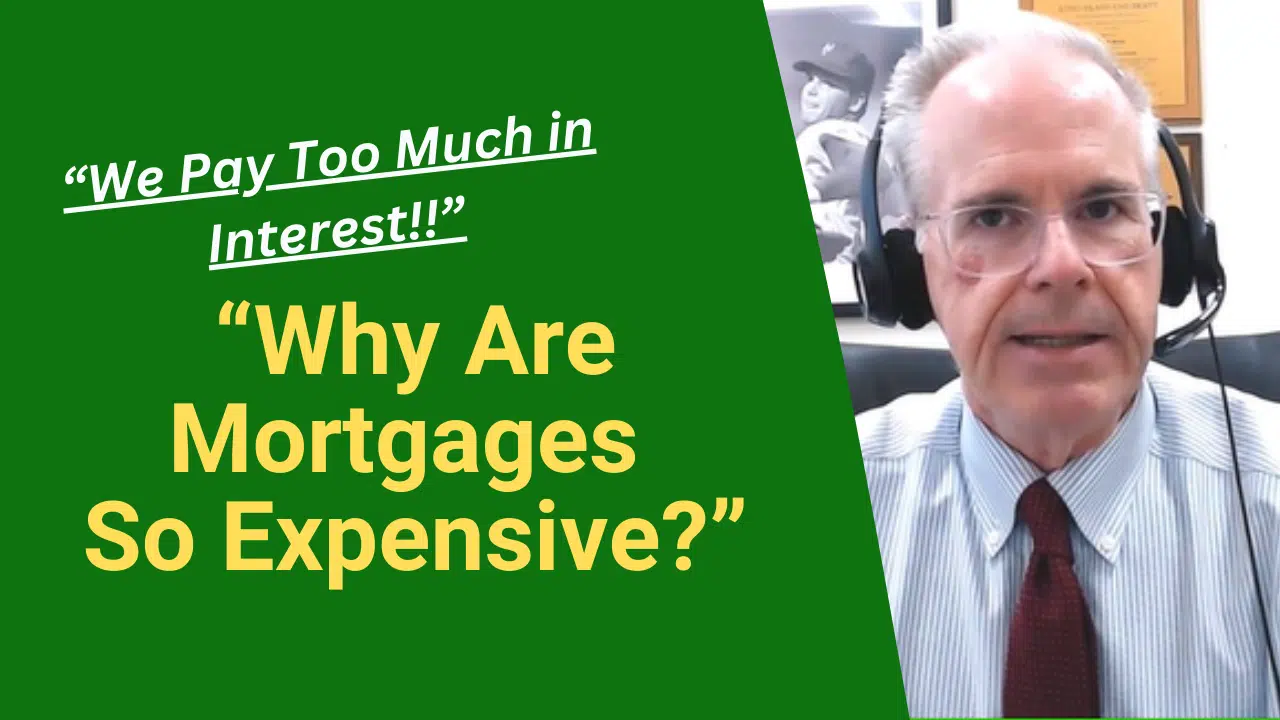
Why are mortgages so expensive?
Is it just the banks being greedy? It seems like all of this interest is front loaded into most mortgages, and we can’t seem to build up any equity in our homes.
When we do this, it takes forever to start building equity. What’s going on with this?
It takes a little bit of understanding how mortgage math works. And also understanding how amortization works, and I’m going to go through some numbers with you.
What I did here was I went to a website called www.calculator.net. It’s free. You could do this too.
I just went to the website and I typed in a $400,000 loan amount for 30 years at 6.5%, and you can see it spit out this annual schedule.
Your monthly payments of principal and interest will be $2,528.27 cents.
Now all I’ve done is paste this into an Excel spreadsheet and we can walk through some numbers here.
You can see that the total payments that you’re going to be making each year over 30 years is the same amount, $30,339.26. In year one, you’ll see 25,000, almost $26,000 of that is interest and very little of it is principal.
And the reason for that is if you’re borrowing $400,000 at six and a half percent — well, some back of the envelope math shows, you’re going to be paying about $26,000 that year in interest.
But what if you had a loan where you were just paying only the interest on this?
Let me show you what that would look like.
Now I put them side by side so you can see if you had a straight line loan where you only paid the interest on a loan for 30 years.
By the way, I don’t think a bank would sign up for this!
But if you paid the $26,000 interest, that’s six and a half percent on $400,000. You see, your balance doesn’t go anywhere, and so at the end of the 30 years, there’s a surprise waiting for you.
You need $400,000 to pay off that loan!
If you’ve ever leased a car, you know what I’m talking about!
So I want to show this to you in a slightly different format.
This is how an amortization loan works.
And if no one’s explained this to you, it’s a super simple illustration. I took that $30,339 that you’re going to pay every year, and I just turned it into a bar chart.
And so each bar represents a year. This is year one.
Year two, year three, year four, and so on.
This is how amortization works. We’re going to draw a line straight through all of these years, and you can see in year one very little principle, mostly interest.
Year two, a little more principle.
Year three, a little more principle.
But what doesn’t change?
Your payment doesn’t change.
But every year, you gain a little more equity with this.
What if you went to the banker and said, “Hey, Mr. Banker, I have a proposal for you. I’m looking at these numbers that we have on our traditional amortized loan. I’m paying you $30,339 every month (year).
I know that at the end of 30 years, I’m going to pay you $910,000.
Here’s the number right there.
I also know that I’m going to be paying out of that $910,000. That $400,000 of it is the original principle that I borrowed.
So $510,000 is the interest that I owe you.
What if we were to take the $30,339 and apply it equally to principle and interest?
When you do the math — what you’re going to find is $400,000 on a total of $910,000 is 43.95% of the payment.
Almost 44% of each payment goes towards principal.
That means that 56.05% of every payment should go to interest.
What if we were to just “smooth out the payments” and pay the same amount of principal every year, and the same amount of interest.
Just do it in equal payments.
Here’s what the math looks like for you. In this case, same payments, $30,339 every single year.
Interest, still the same every single year.
Principal, still the same every single year.
And look, at the end of 30 years, $400 grand is paid off.
You’ve paid $510,000 in interest.
It seems like a pretty fair deal.
Why wouldn’t the bank sign up for something like this?
In the traditional amortized loan, your equity grows very, very slowly.
In fact, at the end of the first year, you have almost no equity.
You’ve got 4,000, $4,400. Okay?
At the end of five years, you’ve got $25,000 in equity in your home.
At the end of nine years, (now) you’re almost a third of the way through your mortgage, you only have $52,000 in equity.
Now look over here.
If you made these equal payments at the end of nine years, holy moly, you’ve got $120,000 in equity.
This is starting to sound like a pretty good deal.
Why wouldn’t people sign up for this?
They should!
If the banks offer something like this!
Why don’t the banks offer something like this?
Because of math.
Let me show you what happens when you have an equal level payment program, okay?
If you pay $17,000 in interest on a balance of $400,000, your effective rate in the first year is about 4.25% percent, not the six and half percent mortgage that you signed up for.
In year four, you’re paying about 4.75% percent interest on the money – because you’re paying $17,000 on $346,000.
Over here in year nine, you’re paying $17,000 interest on just $279,000.
Okay, let’s go down here to year 17. You’re paying $17,000 interest on $173,000 mortgage. That is over 9%.
In fact, the next year it’s almost 10% interest.
Who would sign up for this? Nobody.
And so what happens in a situation like this… if this were available… is you would want to refinance somewhere in this range here.
The bank across the street from this bank would not give you the same kind of deal.
So the reason why we amortize, we… the reason why banks amortize loans is because you’re being charged interest on this… on the ending balance.
And so you are going to be paying six and a half percent this year on $368,261.
Next year you’re going to pay 6.5% percent interest on $361,000. And so on… until you get all the way down to zero.
That’s how the math works out.
And that’s why you pay more interest upfront.
Because you have a larger size loan.
And less interest at the end, and most of your payment works out to be principal.
Hope this math helps some folks gain a better understanding of how mortgages work.
Thanks for watching Mortgage Math: Why You Pay So Much in Interest Up Front