What Is A Sinking Fund?
The sinking fund: the simple way to plan for expenses you know are coming.
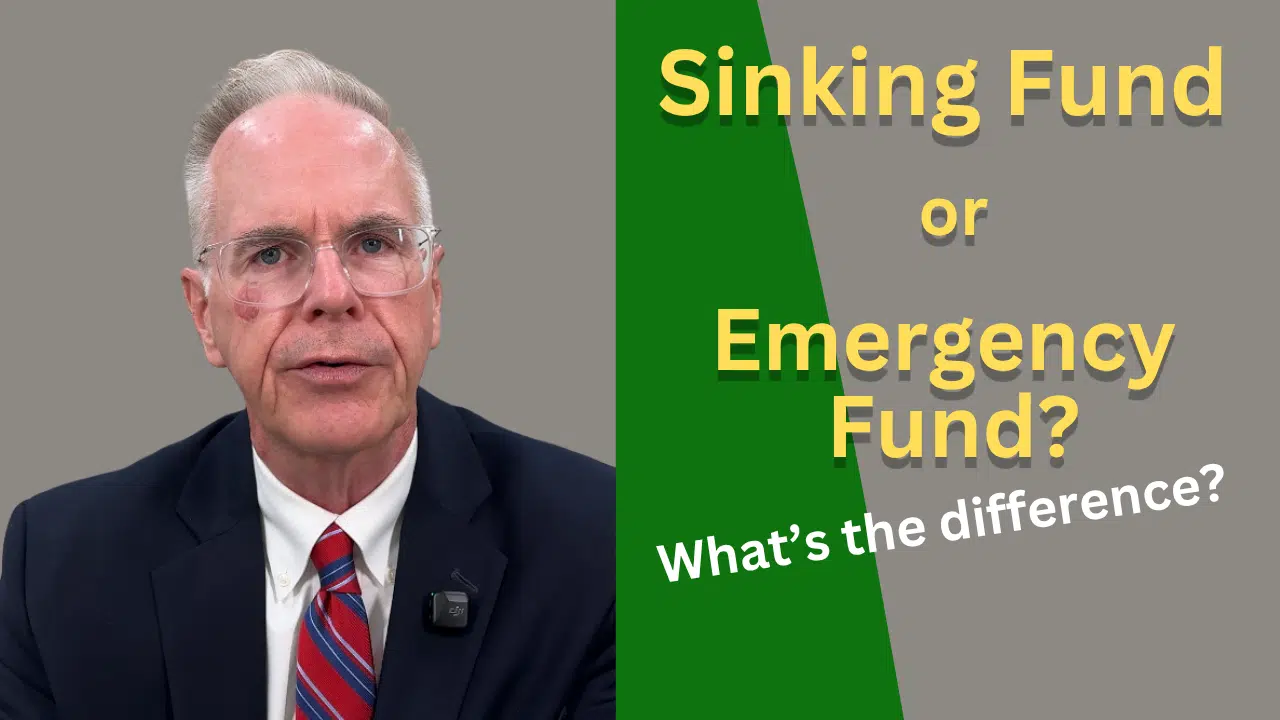
In this video, we cover what is a sinking fund. And how is it different from an emergency fund?
We give examples of sinking funds such as budgeting for office items, car tires, or brakes. Smoothing quarterly estimated tax payments by dividing the annual amount by 12 and saving monthly to avoid scrambling.
The term “sinking fund” was common decades ago, including in municipal finance where sinking funds lowered bond risk.
But many municipalities – and individuals – now live financially on the edge.
We recommend establishing an emergency fund first — at least 3–6 months of expenses, with a preference for 12 months.
Then use sinking funds instead of relying on credit cards, which function like a “sinking fund in reverse.”
Take-aways:
- A sinking fund is a bucket for expenses you know are coming — but can’t date exactly.
- Emergency fund first. Always. Then a sinking fund.
- Tires, brakes, new computers, quarterly taxes — plan for them, don’t get ambushed.
- A credit card is a sinking fund in reverse: you pay after, plus interest.
Links for “What Is A Sinking Fund?”
Catch all our Mullooly Asset videos here
Subscribe to the Mullooly Asset YouTube Channel
Watch this episode (“What Is A Sinking Fund?”) on our YouTube Channel
Transcript for What Is A Sinking Fund?
What is a sinking fund?
And how is a sinking fund different from an emergency fund?
But before I get to that, the very first time that I heard about a sinking fund was in my economics classes back in college.
This was in the fall of 1980. From a book, a textbook that was probably written in the 1970s.
So we don’t hear the term “sinking fund” too much anymore.
Everyone hammers away at the idea of an emergency fund instead, and that’s good.
So what IS a sinking fund?
A sinking fund is a bucket. It’s a separate account that’s used for irregular expenses.
You know these expenses are coming up. But you’re just not sure exactly when you’re going to need it. Or, they’re considered out-of-cycle payments, things like that.
Compared to an emergency fund by contrast, that’s for pure emergencies.
You lose your job.
That’s an emergency.
A tree comes crashing down through your roof.
That’s an emergency.
When a real emergency hits, you’re not going to have enough money in the emergency fund.
You’re going to wish that you had more.
So what are some examples of uses for sinking funds?
Well, here at the office, we replace our computers and our printers every couple of years.
We know that the expense is coming up. So we plan for it.
We’re not exactly sure WHEN it’s going to happen.
But we know that it is going to happen.
So if we plan on, say, four years or 48 months away from sometime now or, or soon, and we know that it’s going to run us approximately $8,000, we can put away $150 or $200 a month into a sinking fund, into a small account.
And we know that when the time comes to order these new computers, these new machines, we’re going to have the money.
Or we’re going to have most of the money sitting there, ready to go.
What are some other examples of sinking funds?
Every 50,000 miles or so, you’re probably going to need four new tires on your car.
If four tires on YOUR car run, say, $1,200, I mean, that could, depending on the length of time you have to go, that could be as little as $25 a month.
Something small.
But you can put the money away on a monthly basis and build it up so you have most of the money ready to go when the time comes.
Same thing with brakes. Brakes are not cheap.
And so you know that this expense is coming.
You can plan for it.
You can be a little prepared for it.
Here’s an excellent example:
Do you pay quarterly estimated taxes?
If you are paying quarterly estimated taxes four times a year, you know it’s not equally spread out.
It’s not every three months.
You pay four times a year, but you pay January for last year.
And then you pay April 15th, that’s three months away.
But then you pay June 15th, that’s only two months away.
And then you pay in September, that’s three months later.
But then you don’t pay again until January.
That’s four months away.
How do you do this?
Well, take the amount that you’re going to owe – or going to need to pay in quarterly estimated payments, divide it by 12, set that aside on a monthly basis.
So you don’t have to scramble and say, “Oh my goodness, it’s September 15th, I’ve got to pay my quarterly estimates.”
Nobody likes to scramble like that.
So this is NOT an emergency.
It’s a known expense that you have coming up.
It’s a perfect example of a sinking fund.
So why don’t we hear more about sinking funds?
When I first heard about it, it was in my economics classes and my initial finance classes back in college.
This is 45 years ago – from a book that was written 50 years ago.
Back then, cities and municipalities that had money set aside in a sinking fund were considered to be lower risk.
They had the money set aside to pay you, the bond holder, to pay you back.
That was considered a lower risk.
So lower risk is going to mean a lower yield.
But in the scheme of things, it was a safer investment.
Today, as you can probably guess…… there’s a lot of municipalities, not just here in New Jersey……. there’s a lot of municipalities that are financial train wrecks.
They’re living close to the edge.
Personally, you know there’s a lot of people living their financial lives in kind of the same way.
They’re living on the edge of a cliff.
It’s scary out there.
And so the first thing you need to do — before you even think about a sinking fund — is have an emergency fund in place.
At a minimum, that’s got to be three months of expenses.
For other people, it’s six months of expenses.
I guess the first thing I should say is you should know what your expenses are.
Uh, you need to figure that number out.
And then have a minimum of three months. For others, it’s six months.
For me and others, I prefer to have 12 months of expenses.
I can sleep at night knowing that my expenses are covered…… for a year – if something goes wrong.
Because when that emergency hits, you are not going to have enough.
You’re gonna wish that you had more.
Another reason why people don’t use sinking funds today? Credit cards.
$2,000 brake job…… or getting new tires?
Put it on a credit card.
And you take a vacation?
Put it on a credit card.
And why not?
“I get points, right?
I get points!”
Have you ever examined the dollar value of those points?
If you want to see inflation in action, just look at what’s happening to the value of your points.
It’s a losing game, most of the time, doing something “to get the points.”
And then what really happens when you put money on a credit card, it becomes “a sinking fund in reverse.”
So you put a $2,000 expense, like brakes, or a small vacation, on a credit card.
And instead of sending money into a sinking fund — in advance, you’re paying $200 every month to “Mr. Visa.”
It’s really not the way to do it.
If you want to be more deliberate with your finances…… you’ll discover that “it’s not luck, it’s planning.”
And we talk about that in the next video here.