Should My Financial Advisor Talk to My CPA?
Should my financial advisor talk to my CPA?
For the best outcomes, we feel the answer is yes.
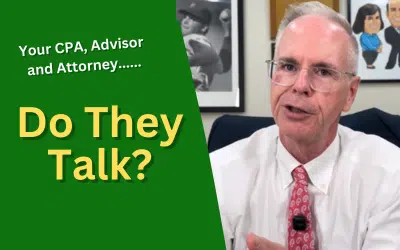
When your accountant, advisor, and attorney don’t talk to each other, problems can develop.
And you’re usually the one who pays, when problems develop.
It’s a question clients ask us all the time. Each professional holds just one piece of your financial life, and the real value comes from connecting those pieces — not from any one of them working alone. So when clients ask, should my financial advisor talk to my CPA? The answer is nearly always going to be yes.
Take-aways:
- The best financial outcomes often come from coordination, not from any single professional being the smartest in the room.
- Your advisor, CPA, and attorney often work in silos. They might never speak unless someone makes them.
- Common, costly examples of that gap: an unfunded trust, or a Roth conversion that wrecks your tax bracket.
- AI and DIY can’t fix this. You’ll get answers in a vacuum, with no one connecting the dots.
Links for Should My Financial Advisor Talk to My CPA?
Catch all our Mullooly Asset videos here
Subscribe to the Mullooly Asset YouTube Channel
Watch this episode (“Should My Financial Advisor Talk To My CPA?”) on our YouTube Channel
Transcript for Should My Financial Advisor Talk to My CPA?
Clients who seem to get the best results aren’t the ones with the smartest advisor, or the best accountant, or the sharpest attorney.
Or even with the biggest pile of money.
No. The clients who seem to get the best results are the ones whose advisor, accountant, and attorney all talk to each other.
What a lot of people don’t realize is that these professionals usually operate in their own separate silos.
And so in a lot of situations, we see folks coming into our office for the first time, and they’ve got:
– a CPA who does their taxes,
– they’ve got someone who handles the investments, and
– they’ve got an attorney who drew up their estate planning documents.
And often, they haven’t spoken with each other.
Sometimes they’ve NEVER spoken with each other.
Getting these people in the same conversation, seems a lot harder than it should be.
And when they’re not on the same page, the person who pays for it…… is you.
For example, a tax move that your advisor makes, but your CPA doesn’t know about.
Or, an estate planning decision that your attorney handled, but no one coordinated with the investments.
Let me give you a perfect example of this, an unfunded trust account.
This happens a lot.
Trusts get set up by an attorney.
But nothing in the investment side, nothing has been retitled into the name of the trust.
This happens a lot more than it should.
Or a Roth conversion that, on paper……. made a lot of sense.
But then it blew up your tax bracket because no one was looking at the entire picture.
These aren’t rare.
They happen more than they really should.
They happen, though, when smart people work in isolation.
And what I’m starting to worry about….. more and more of late is some people are just trying to “do it all themselves.”
Whether that’s in an effort to keep costs down, they’re deciding to be their own quarterback.
They’re trying to be their own lawyer.
They’re trying to be their own advisor.
They’re trying to be their own tax pro.
Or lately, they’ll consult on a matter with artificial intelligence.
Understand, AI doesn’t know your accountant, hasn’t read your estate planning documents.
It doesn’t know your tax status.
For example, if you’re harvesting tax losses.
It doesn’t coordinate with anyone.
It’ll give you a solid answer, a clean answer, but it’s in a vacuum.
That’s not how life really works.
The worst outcomes that I see come from decisions made alone….. with no one connecting the dots.
The best outcomes just seem to happen when everyone is on the same side of the table, working the same plan.
That’s not more expensive.
It’s what prevents expensive mistakes.
Our job often is to be the one who gets everyone into the same room.
The question isn’t:
Do I have a good advisor?
Do I have a good CPA?
Do I have a good attorney?
No.
It’s “do they know each other’s names?”
And if you want an example of how one of these decisions can go off the rails, when it’s made in isolation, watch this video next……
Thanks for watching “Should My Financial Advisor Talk To My CPA?”